
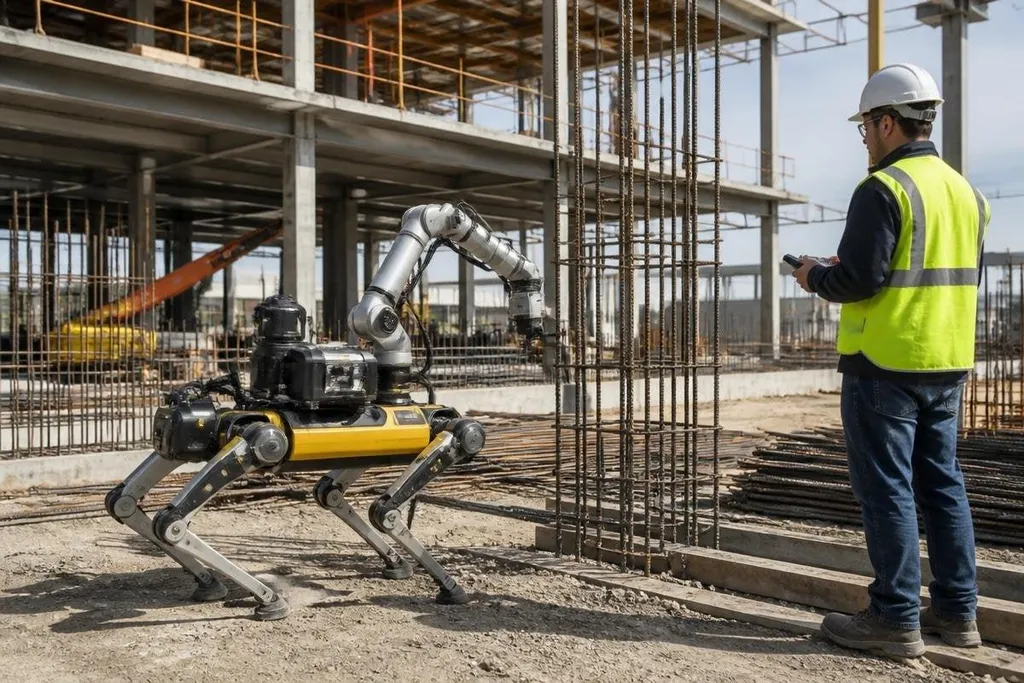
Construction robots are moving from lab floors toward bricklaying, site mapping, rebar work, drywall handling, and inspection. The hard part is no longer making a robot move; it is making that movement useful on a changing job site.
- A useful robot must finish a defined task, not only perform a smooth demo.
- Dust, uneven ground, weather, and changing materials can decide whether a system works.
- Buyers need task results, safety data, setup needs, and service costs before choosing a machine.
The task comes before the robot
Construction companies do not buy walking machines for their own sake. They need a machine to carry materials, place components, scan a structure, mark layout points, or repeat a task that puts people in awkward or unsafe positions.
That makes the work target the first test. A robot for bricklaying needs steady placement, a way to handle different bricks and mortar, and a plan for moving around an active site. Inspection systems need sensors that produce usable records, not only a video of the robot looking at a wall.
The same rule applies to rebar tying, concrete finishing, demolition, and earthmoving. Each task has its own tools, tolerances, work speed, and safety risks. A machine that performs well in one area may have little use in another.
Job sites punish clean demos
A factory gives a robot marked floors, fixed lighting, known parts, and a stable work area. A construction site changes as the building takes shape. Materials move, surfaces become uneven, and other crews work nearby.
Those conditions affect sensing and control. Cameras can lose useful detail in dust or glare. A mobile robot can meet steps, loose cables, slopes, or a path blocked by stored materials. An arm may reach the target but fail when the target sits at a different height or angle.
The buyer should ask what happens after the first failed attempt. Does the robot stop safely? Can a worker move it by hand? Does a remote operator take control? How long does recovery take, and who pays for the extra labor?
A good trial records those details. It should show the task before the robot arrives, the setup time, the number of completed work cycles, the failed cycles, and the work left for people. A polished clip cannot answer those questions on its own.
A construction robot’s result needs a clear record: the named machine, job site, task, cycle count, and point where a worker took over. Robot24.com can help you find those details before the race turns to shared measures.
The race needs shared measures
The phrase “global race” suggests a clear contest, but construction robots do not compete on one score. A bricklaying system, a site-scanning robot, and a lifting machine solve different problems.
Shared measures help buyers compare those systems. Record completed work per shift with human setup time included, the time needed to move the system between work areas, and how often a person takes control. Also record safety stops, near misses, restart time, training, service, and replacement-part needs.
The figures should come from a named site or a recorded trial. A test inside a controlled facility can show that a mechanism works.
It does not show that the same machine can keep working beside other crews, changing materials, and real delivery schedules.
Price also needs a clear boundary. The purchase cost may exclude the operator, transport, site changes, software fees, maintenance, and downtime. A lower machine price can lead to a higher job cost if setup takes longer than the task itself.
What remains unproven
Many construction robots still need more public evidence from ordinary sites. That evidence should cover different weather, layouts, materials, and work teams. It should also show failure rates over a full project phase rather than one successful run.
The safety case needs the same care. A robot sharing space with workers needs clear stop controls, warning signals, movement limits, and a process for faults. These are working requirements, not items to leave for a later software update.
I'd fund a construction robot only after the maker publishes task results from a site that matches my work, including failed runs and human labor around the machine.
A buyer's site checklist
Use these questions before a trial or purchase:
- Name the task: What exact work will the robot complete, and what result counts as finished?
- Record the setup: How many people, tools, hours, and site changes does each shift need?
- Test the bad conditions: Include uneven ground, changed materials, poor lighting, dust, and blocked routes when they fit the job.
- Measure recovery: Log every stop, remote takeover, reset, and manual repair.
- Price the full job: Add transport, training, service, software, supervision, and lost time.
- Set the exit rule: Decide in advance which result ends the trial or moves it to another site.
The next useful proof will not be a smoother demo. It will be a public work record showing the task, the failures, the labor still needed, and the cost per completed result.